
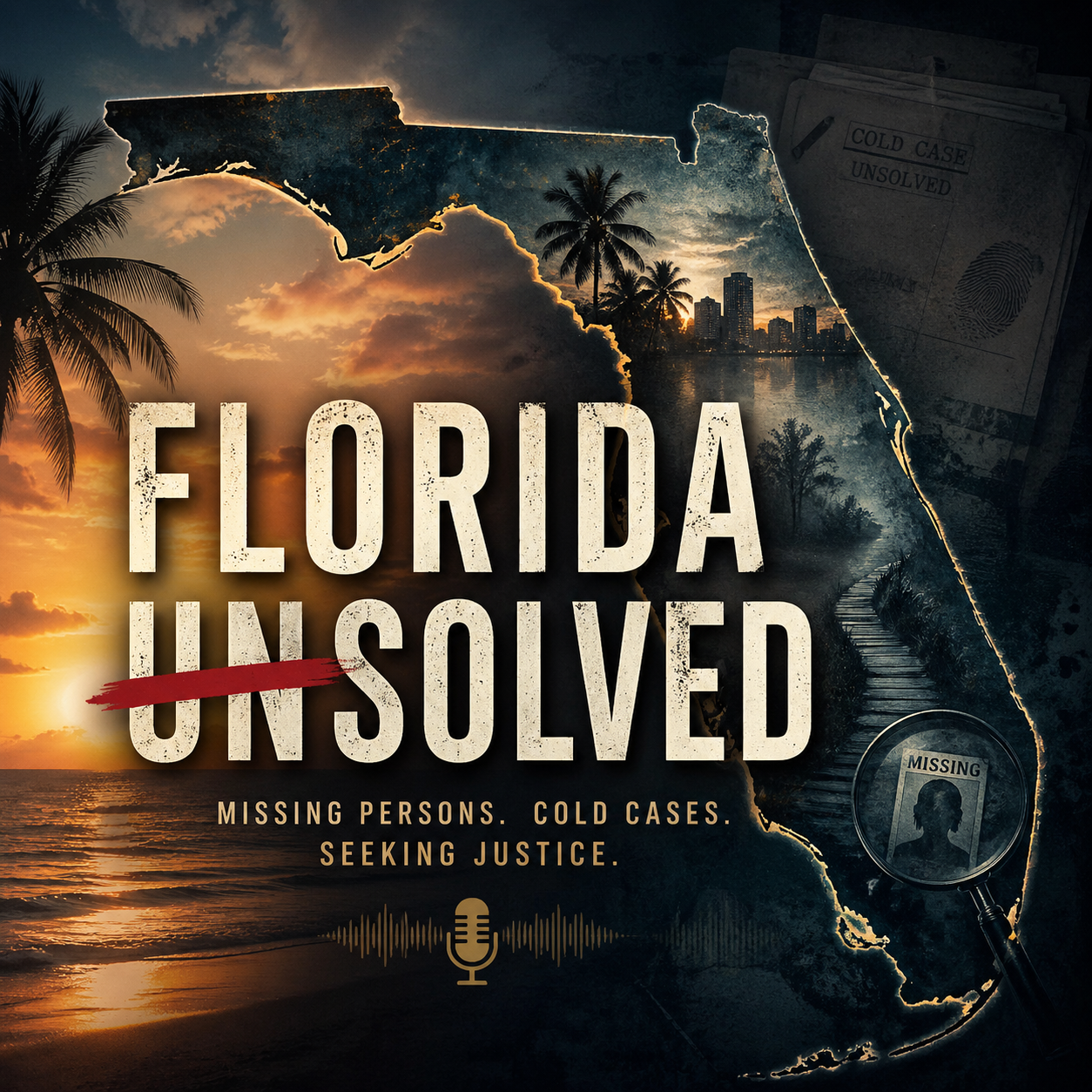
Florida Unsolved
Every name. Every case. No expiration date.
Unsolved isn't the same as over.
Florida Nonprofit
Florida Unsolved is a nonprofit investigative journalism organization dedicated to keeping the public record alive for the state's unsolved murders, cold cases, and missing persons. Time, bureaucracy, and institutional silence are not acceptable reasons to let a case go dark.
Founded in May 2019, Florida Unsolved began as an investigative journalism project examining the then-unsolved murder of Dorothy Thomas. Its initial effort produced four articles before the project became inactive. Research and development resumed in 2021, followed by a hiatus and a sustained return to active work in 2023.
In February 2024, authorities announced that the Dorothy Thomas case had been closed through exceptional clearance. Florida Unsolved incorporated as a nonprofit in 2025, expanding its work to additional Florida cases through case research, publications, and the development of investigative findings.
We work at the intersection of investigative analysis, journalism, law, and science — combining rigorous public records research under Chapter 119, Florida Statutes with open-source intelligence, forensic nursing analysis, criminal profiling, and legal nurse consulting. Our investigations are supported by modern technology, including AI-assisted research tools, reflecting our commitment to bringing every available resource to bear on cases that have gone unanswered for too long. Cases span decades. The only prerequisite is that the case remains unsolved.
All investigative work conducted by Florida Unsolved relies on open-source research, public records, and Chapter 119 public records requests. We support and cooperate with law enforcement and licensed investigators, and serve as advocates for victims and their families — never as a substitute for official investigation.
The Method
Florida Unsolved is not a podcast with a Patreon. It is an investigative platform with one mandate: work every case until the record is complete.
Case files are built on public records requests, forensic document review, open-source intelligence, witness research, and linguistic deception detection — not speculation, not dramatization. Where gaps exist in the record, we name them. Where the evidence speaks, we follow it.
We coordinate with law enforcement where appropriate. We do not publish to entertain. We publish because unsolved isn't the same as over.
About the Founder
Shane Huey is a clinical-forensic analyst, legal nurse consultant, and healthcare IT Analyst who brings a multidisciplinary approach to cold case and missing-person investigation. He holds an MS in Information Security specializing in OSINT, cybercrime, and digital forensics; an MBA in IT Management; and a postgraduate diploma in Criminal Profiling and Crime Scene Analysis.
A multistate-licensed registered nurse (NLC) and licensed private investigator (Anchorage, AK), Shane's professional affiliations include the Florida Association of Private Investigators, Academy of Forensic Nursing, American Association of Legal Nurse Consultants, International Association of Forensic Criminologists, and Investigative Reporters and Editors (IRE).
His investigative training includes a Forensic and Investigative Sciences certificate through Texas A&M Engineering Extension Service (TEEX), with coursework encompassing criminal investigation and Missing and Exploited Persons, alongside training in OSINT, digital forensics, medico-legal death investigation, bloodstain pattern analysis, the Reid Technique of Investigative Interviewing, statement analysis, forensic linguistics, and facial-expression analysis through the Paul Ekman Group. Together, these disciplines inform a multidisciplinary approach to the missing-person and cold cases Florida Unsolved examines.
His clinical and healthcare-technology background adds another dimension to that work: more than a decade working with complex electronic health record systems and experience examining chronology, documentation, provenance, metadata, and discrepancies across records and other evidence.
The result is an investigative approach built around a simple discipline: separate what the evidence establishes from what we infer from it — then test the inference.