
Florida Unsolved returns to the case that began its reporting in 2019 — a young woman’s life, a decades-long search, and the evidence behind the decision to close Tallahassee’s oldest unsolved homicide.
Status: Exceptionally cleared · Announced February 21, 2024Florida Unsolved began with Dorothy Blanchard Thomas. The first overview of her murder appeared on May 25, 2019, followed by examinations of the crime scene, the claims circulating about the case, and Dorothy’s life. Those articles established the approach behind this project: return to the records, examine what they actually establish, and remember the person whose name appears on the file. [1][2][3][4]
The original reporting described a murder that had remained unresolved for more than six decades. On February 21, 2024, Tallahassee authorities announced a different status. Following a task-force review, they attributed Dorothy’s murder to longtime suspect Harry Barth and cleared the case by exceptional means because he had died. No arrest or trial followed. [5]
This retrospective brings those two periods together. It begins with Dorothy, then examines the original investigation and the distinction between identifying a suspect, establishing probable cause, and proving guilt.
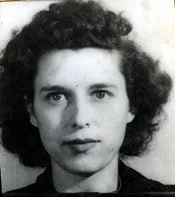
Dorothy Blanchard Thomas.
The woman before the case
Dorothy Eleanor Blanchard was born on April 20, 1930. The birth-index image preserved in the original reporting lists “Dorothy E.” and “Saratoga Spgs.” The 2019 biographical account placed her family in the Johnstown–Rockwood area of New York and identified her parents as S. R. and Jennie Blanchard. She signed her letters “Dot.” [4]
That small detail survives differently from a date on an evidence inventory. It belongs to the person her family knew.
The earlier reporting described two brothers, Glennis and Alton, and work in Columbus, Georgia, including employment at the Plaza Restaurant and Newberry’s. Dorothy met Kenneth Earl Thomas while he was serving in the Army. They later spent time in Germany during his military service before settling near Tallahassee, in Woodville. The original account placed their marriage in January 1953 but acknowledged that it had not located a marriage record. That qualification remains necessary. [4]
According to the 2019 account of the investigative materials, people interviewed described Dorothy favorably as a dependable employee and a friendly, hardworking woman. Her life had involved work, family, travel, and the adjustments of a military marriage. Her murder would eventually become the most widely repeated fact about her. It should not become the only one.
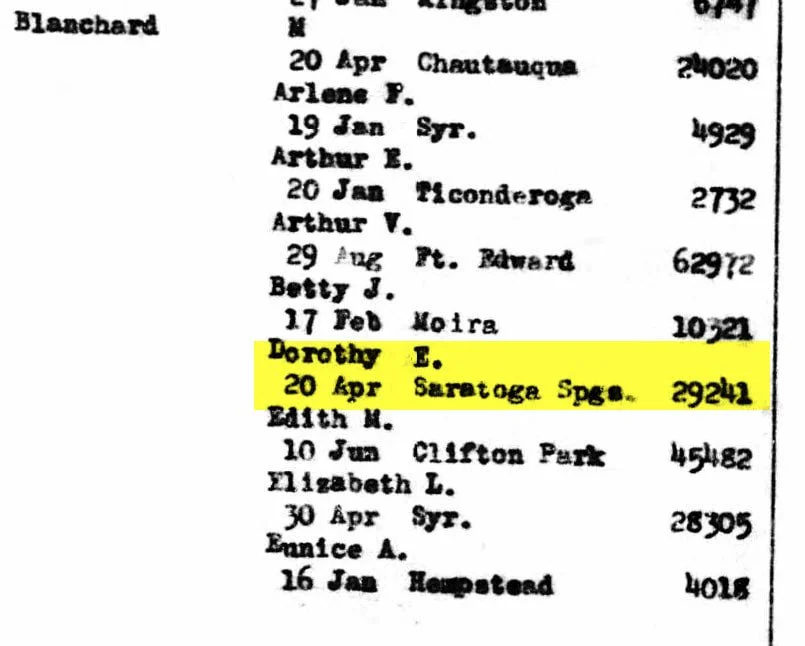
Birth-index excerpt reproduced in the original biographical article. The highlighted entry lists Dorothy E. Blanchard, April 20, Saratoga Springs. This cropped image is an index entry, not a complete birth certificate.
September 6, 1957
Dorothy was 27 when she was killed at the dry-cleaning business at 633 West Tennessee Street in Tallahassee. The original articles call the business New Way Laundry and Dry Cleaners; the city’s later announcement calls it Nu Way Cleaners. Both accounts identify the same address. [1, 5]
The earlier reporting states that she began work for the business in April 1957 and was managing the Tennessee Street location by August. On Friday morning, September 6, Coca-Cola deliveryman Clarence Rhames discovered her body in the restroom. [1, 4]
The exact discovery time should be treated cautiously. The May overview places it shortly before 10 a.m.; the June crime-scene article gives approximately 9:35 a.m. Without reconciling the underlying dispatch records and witness accounts, a retrospective should preserve that discrepancy rather than manufacture a precise timeline. [1, 2]
Dorothy had sustained numerous stab wounds, principally to the neck region. The original reporting and later news coverage give different counts. This article does not adopt a definitive number without the complete autopsy report. Nor does it repeat earlier speculation about her awareness, the duration of the attack, or the precise movements of her assailant.
Those details require evidence of their own.
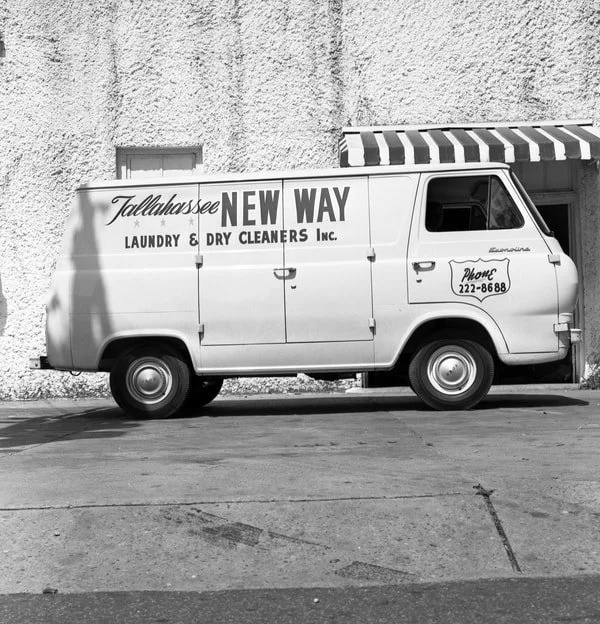
New Way Laundry & Dry Cleaners delivery van, Tallahassee, 1961. State Archives of Florida, Florida Memory, as credited in the original post. The photograph dates from four years after the murder.
What the scene could establish
The June 1, 2019 article described clothing on the front counter, marks interpreted as evidence that Dorothy had been dragged toward the restroom, and her eyeglasses on the floor. It also described money and personal property remaining at the premises. These observations informed the original reconstruction, but they do not establish every step in the sequence. [2]
Clothing positioned for a transaction may indicate that a customer was being served. It does not identify the assailant without additional evidence. Property left behind may weigh against a completed theft, but it does not categorically eliminate every robbery-related scenario. The absence of a documented sexual assault likewise does not establish the offender’s motive.
The scene sketch is useful because it preserves the spatial relationships recorded by investigators. It cannot independently establish how Dorothy was restrained, the assailant’s handedness, or the route used to leave. The original article proposed some of those possibilities. Here, they remain hypotheses rather than findings.
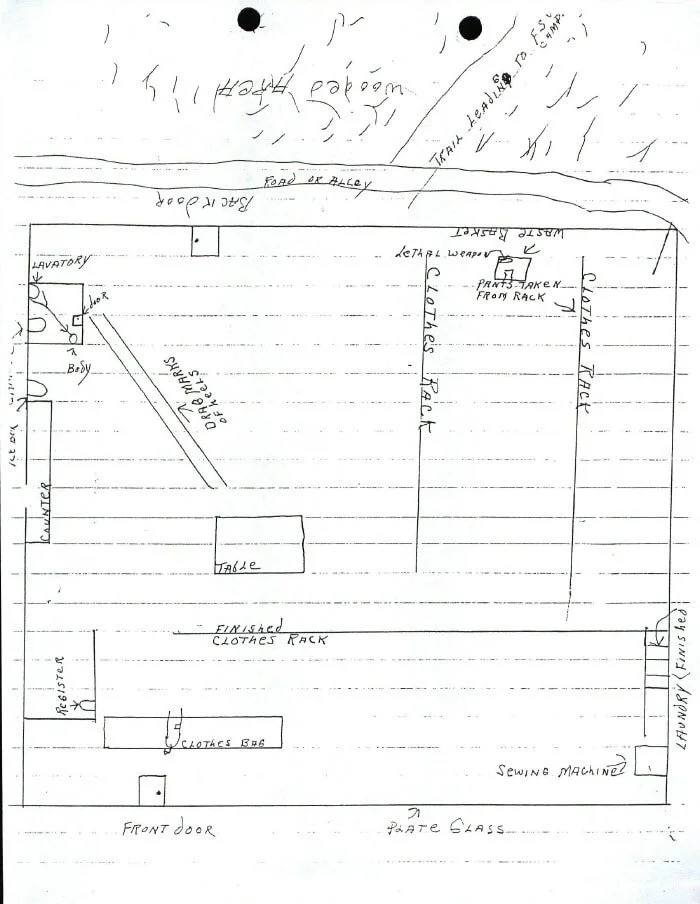
Original scene sketch reproduced in the June 1, 2019 article. Its value is the recorded layout and annotations; it should be read alongside the underlying reports rather than treated as a complete reconstruction.
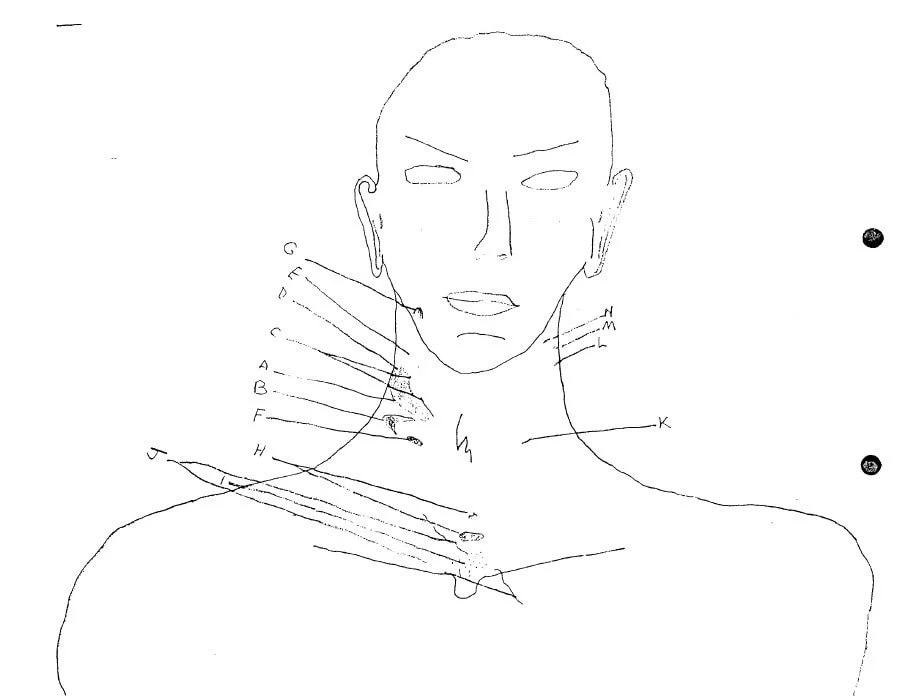
Anatomical drawing reproduced in the original crime-scene article. It depicts injury locations but is not a substitute for the complete autopsy report or a forensic pathologist’s interpretation.
The evidence inventory — and the limits of the surviving excerpts
Three inventory pages survive in the published archive. They record items collected from different people and locations, including clothing, jewelry, a dry-cleaning bag bearing the name Barth, eyeglasses, samples, and latent impressions. An inventory establishes that an item was recorded. Its significance depends on where it came from, when it was collected, how it was handled, and what subsequent examination established. [2]
The distinction is especially important for the knife. The earlier prose places a suspected weapon at the rear of the business. The displayed inventory records a U.S. Army-type mess-kit knife from a trash basket inside the laundry. Those descriptions need to be reconciled against the complete collection reports. The original fact-versus-fiction article also reported that laboratory examination detected blood, but the displayed excerpts do not provide the complete laboratory findings or establish whose blood it was. [2, 3]
Some examination results were deliberately redacted in the original publication. Those redactions remain in the reproduced images. Nothing in this retrospective attempts to reconstruct the concealed text.
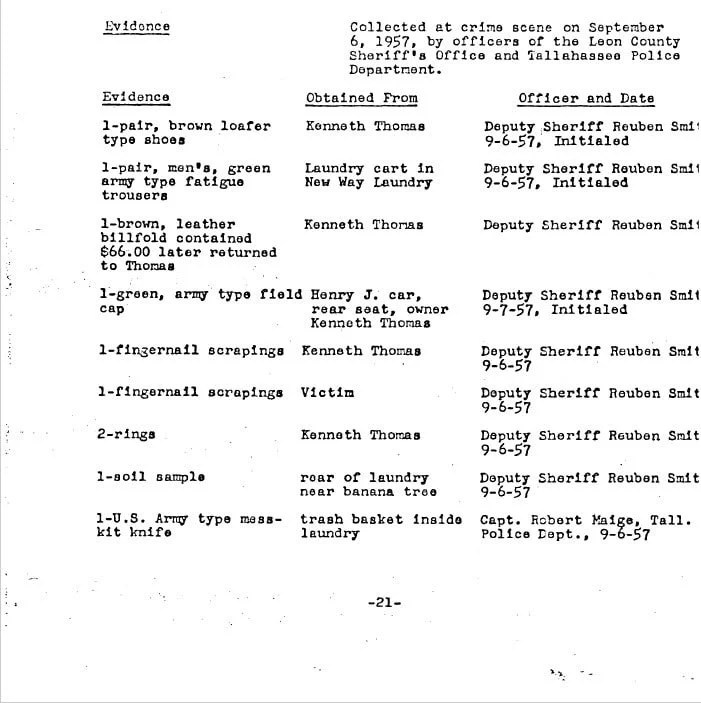
Evidence inventory, page 21. Preserved as published in 2019, including its original marks and wording. The listed knife location warrants comparison with the collection reports.
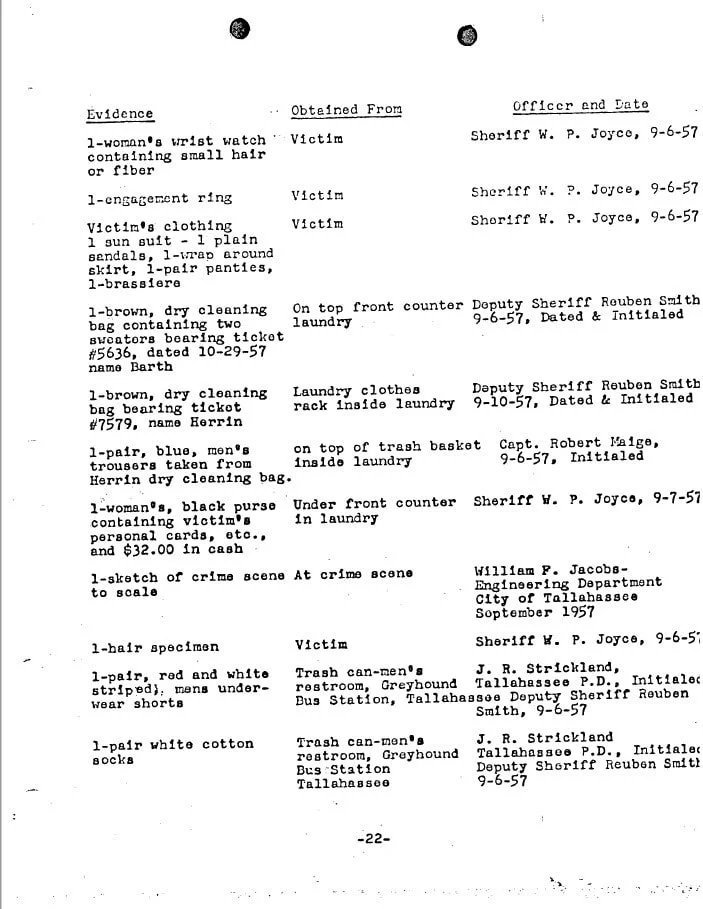
Evidence inventory, page 22. Includes a dry-cleaning bag bearing the name Barth. Names, dates, item descriptions, and collection details require reconciliation with the complete file before further conclusions are drawn.
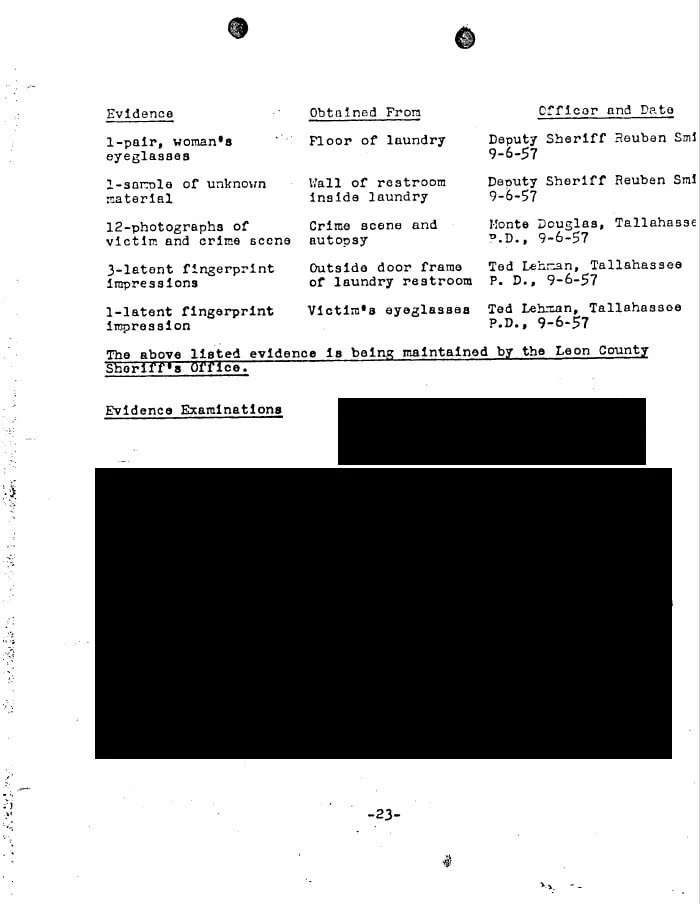
Evidence inventory, page 23. The examination-results section was redacted in Florida Unsolved’s original publication; those redactions are preserved.
Suspicion, repetition, and the original investigation
The June 4, 2019 article challenged the assumption that Dorothy’s husband necessarily committed the murder. It discussed investigative attention directed toward Kenneth, but also circumstances the author considered inconsistent with the prevailing online theory. Its broader point remains sound: repetition does not convert suspicion into proof. [3]
One argument in that earlier article needs qualification. The failure to arrest someone does not establish that the person was innocent, just as an accusation does not establish guilt. The appropriate inquiry is what evidence supported each theory, what contradicted it, and what investigators could establish at the time.
The original reporting also resisted the claim that law enforcement had simply ignored the case. It described a 501-page file supplied by the Leon County Sheriff’s Office, correspondence between Sheriff W. P. Joyce and Dorothy’s mother, and investigative activity extending across decades. Those descriptions are part of Florida Unsolved’s documented reporting history. They do not amount to an independent finding that every investigative decision was correct. [3]
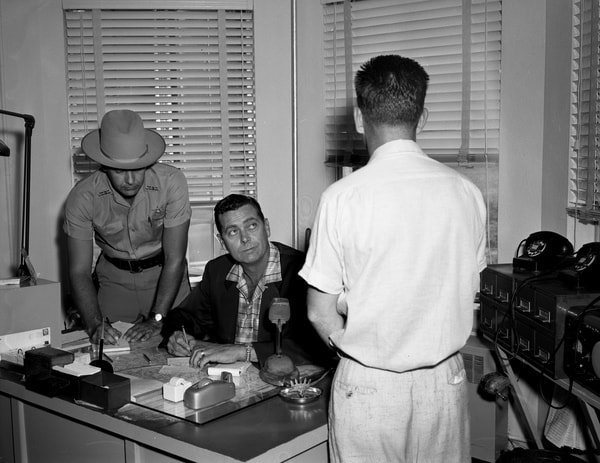
Leon County Sheriff W. P. “Bill” Joyce at his desk, Tallahassee, 1958. State Archives of Florida, Florida Memory, as credited in the original article.
The decision announced in 2024
The Big Bend Cold Case Task Force brought together Tallahassee police, the Leon County Sheriff’s Office, FDLE, and the Second Judicial Circuit State Attorney’s Office. Its February 21, 2024 announcement stated that a review established probable cause to attribute Dorothy’s murder to Barth, a customer investigated in 1957. Barth had died in 2019. The case was cleared exceptionally, without arrest or charges. The city reaffirmed that disposition in August 2025. [5, 6]
Contemporaneous reporting by the Tallahassee Democrat, drawing on a task-force memorandum, identified several grounds for suspicion: Barth’s clothing at the counter, an apparent collection-record inconsistency, muddy shoes that later disappeared, an unconfirmed alibi, and equivocal statements during questioning. It also reported his continued denial in a 1997 interview and characterized the closure as a case-file reassessment rather than a new DNA identification. [7]
Those details help explain the official conclusion. They also require the underlying interviews, records, and context to evaluate independently.
What exceptional clearance means
Under FBI crime-reporting guidance, exceptional clearance requires more than a suspect’s death. The agency must identify the offender, possess sufficient evidence to support arrest and charging for prosecution, establish the offender’s location, and encounter a circumstance outside its control that prevents prosecution. Death is one recognized circumstance. [8]
That classification records a law-enforcement determination. It is not a conviction. No trial tested the evidence against Barth, and no jury returned a finding of guilt. Equally, the absence of a trial does not demonstrate that investigators were wrong. It means the evidentiary assessment ended without that form of adversarial testing.
Did authorities get it right?
The available record supports treating Barth as a substantial suspect. The official announcement states that investigators reached probable cause. The materials reviewed for this retrospective do not permit an independent conclusion that every part of the attribution has been established.
The counter evidence requires particular care. Clothing bearing a customer’s name connects that customer to the business. The stronger question is whether the transaction records, witness accounts, and timing place him there during the relevant interval. A missing pair of shoes or an inconsistent explanation can add weight, but assessing that weight requires the original observations and any comparison findings.
The same discipline applies to the reported interview statements. Conditional language about what someone might have done is not automatically a confession. Its significance depends on the complete exchange, the questioning, the speaker’s condition, and corroboration. Descriptions of temperament or psychological characteristics cannot substitute for evidence linking a person to a particular crime.
A complete assessment would require the closure memorandum and supporting attachments; the relevant interview records; the clothing and transaction documentation; the available laboratory and impression examinations; and the analysis of alternative suspects. These are the materials needed to examine the reasoning behind the determination. This retrospective has not reviewed that complete closure package.
The conclusion must therefore remain proportionate: authorities identified Barth as responsible and closed the case on that basis. The published evidence explains why he attracted serious suspicion. It does not justify claiming that this retrospective independently proves his guilt — or that the closure was improper.
Returning to Dorothy
Dorothy’s case began Florida Unsolved’s published reporting on May 25, 2019. Revisiting it requires updating its status and reconsidering the language used to describe the evidence. Some early interpretations were stronger than the published material could support. A retrospective should correct that, not preserve it for the sake of continuity.
The case is now exceptionally cleared. Dorothy never received the public accounting that a trial might have provided, and readers should be able to distinguish the official determination from the questions that cannot be independently resolved from the available material.
She was 27. She had worked, traveled, married, and written letters home as Dot. Her story deserves an account that preserves those facts with the same care applied to the evidence of her death.
Sources and reporting note
This retrospective combines the four Florida Unsolved articles listed below and updates them using official announcements and attributed contemporary reporting. The earlier articles were predicated upon review of a 501-page investigative file; that complete file was not revisited for this retrospective. Nine editorial images are retained, with their existing redactions and qualifications. The legacy site logo and platform graphics are not treated as case photographs.
The Murder of Dorothy Thomas May 25, 2019
Dorothy Thomas: The Crime Scene June 1, 2019
The Dorothy Thomas Murder: Fact vs. Fiction June 4, 2019
Who Was Dorothy Thomas? June 9, 2019
City of Tallahassee: Big Bend Cold Case Task Force Formed to Pursue Justice in Unsolved Cases February 21, 2024
City of Tallahassee: Big Bend Cold Case Task Force Launches New Website August 13, 2025
Ana Goñi-Lessan, Tallahassee Democrat: Case closed on oldest unsolved Tallahassee murder; TPD seeks tips on other cold cases (syndicated by AOL) February 21, 2024
FBI Uniform Crime Report: Offenses Cleared 2012 reporting guidance